Finance
The financial position of the business in one screen, and the reports behind it.
DigitalKey ERP — Docs · digital-key.co/docs/finance
finance.view3,000 IQD / monthOverview
Where the dashboard answers “how is trading today”, finance answers “is the business actually making money”. Every figure is for a period you choose.
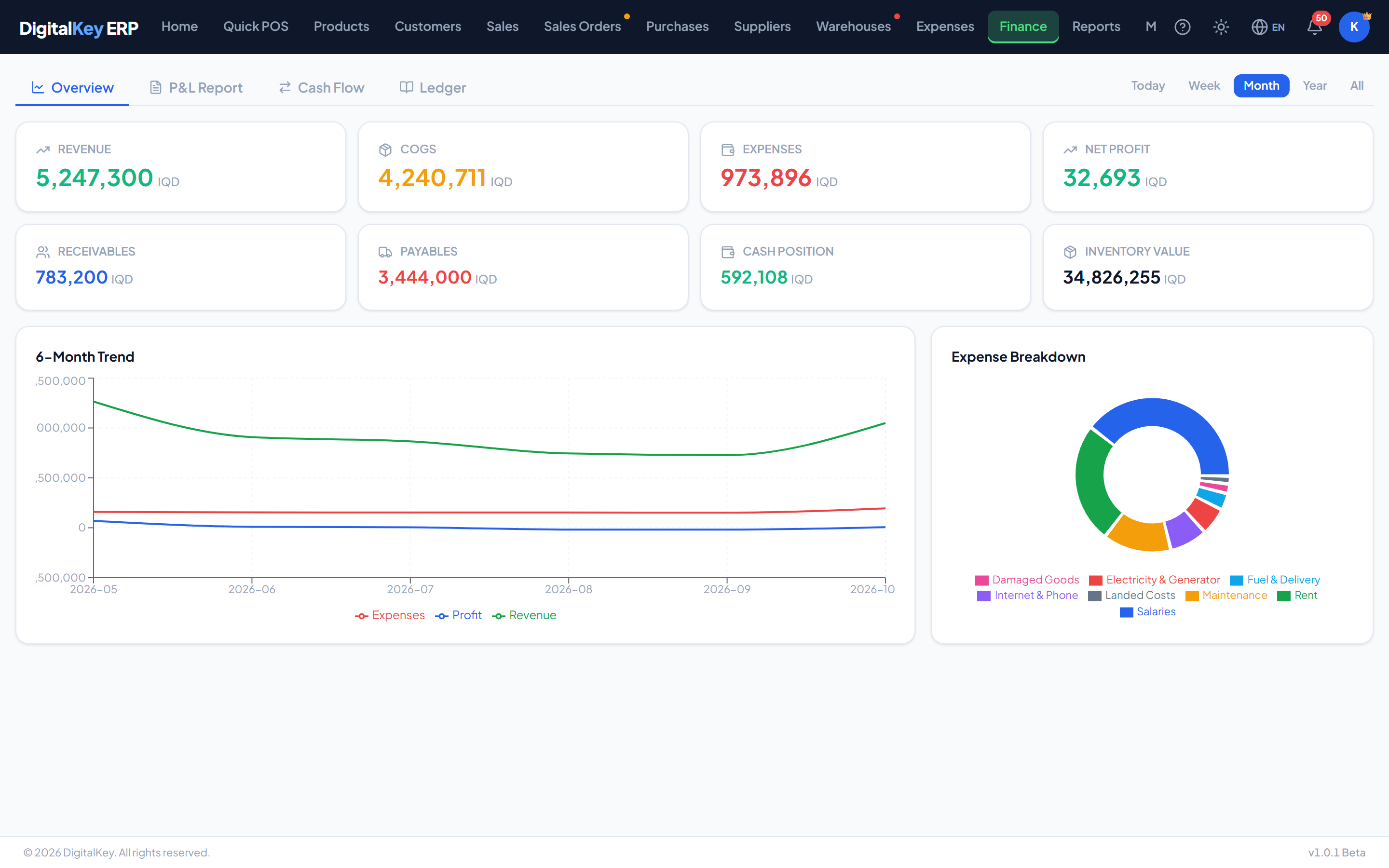
The summary
| Parameter | Type | Required | Description |
|---|---|---|---|
period | string | Optional | The period being reported on. |
from_date | date | Optional | Start of the period. |
to_date | date | Optional | End of the period. |
revenue | decimal | Optional | Value of everything sold in the period, less returns made in the period. |
cogs | decimal | Optional | Cost of goods sold — what those items cost you at the moment each was sold, less the cost of goods returned. |
gross_profit | decimal | Optional | Revenue less cost of goods. |
total_expenses | decimal | Optional | Expenses recorded in the period. |
net_profit | decimal | Optional | Gross profit less expenses. The bottom line. |
invoice_count | integer | Optional | Number of invoices in the period. |
total_receivables | decimal | Optional | Money owed to you by customers. |
total_payables | decimal | Optional | Money you owe suppliers. |
cash_collected | decimal | Optional | Cash actually received in the period. |
inventory_value | decimal | Optional | Value of stock on hand, at today's average cost. |
What the figures count
Finance, the reports and the dashboard all follow the same rules, so the same period gives the same answer on every screen.
| Parameter | Type | Required | Description |
|---|---|---|---|
A sale | rule | Required | A POS sale or a completed sales order that is not void. A draft, pending or approved order is not revenue and carries no cost. |
Returns | rule | Optional | Reduce revenue and cost of goods in the period the return happened — never the period of the original sale. |
Cost of goods | rule | Optional | The cost frozen on each line when it was sold. Changing a product's cost later does not rewrite past profit. |
Damage | rule | Optional | A loss in profit and loss, but not cash going out. |
Landed costs | rule | Optional | The share for goods still in stock raises their cost; the share for goods already sold is an expense. |
Currency | rule | Optional | Everything is in the business's main currency. Showing one invoice in another currency is display only and is never read here. |
revenue and cash_collected are different numbers and both matter. Revenue counts what you sold; cash collected counts what you were actually paid. Sell heavily on credit and revenue can look healthy while very little money has arrived.Receivables and payables
These are the two sides of what is outstanding. Receivables come from postpaid sales; payables come from buying on credit.
finance.debts2,000 IQD / monthMonthly trend
| Parameter | Type | Required | Description |
|---|---|---|---|
month | string | Optional | The month, as yyyy-MM. |
revenue | decimal | Optional | Revenue that month. |
cogs | decimal | Optional | Cost of goods that month. |
expenses | decimal | Optional | Expenses that month. |
profit | decimal | Optional | Net profit that month. |
The ledger
The ledger is your cash book: every movement of money in the period, one row each, newest first, with the balance after each one. It is the Cash Flow report itemised — its money in and money out are the Cash Flow totals for the same period, so when a cash figure looks wrong, this is where you find the sale, payment or expense behind it.
Opening balance + money in − money out = closing balance. Filtering by type or searching narrows the rows but never changes the balance column: it is always the real cash after that row.
| Parameter | Type | Required | Description |
|---|---|---|---|
Sale | in | Optional | What was paid at the till, or when a sales order completed. |
Customer payment | in | Optional | A customer settling their debt. |
Refund | out | Optional | Money handed back on a return of a paid sale. |
Purchase | out | Optional | What was paid when the purchase was recorded. |
Supplier payment | out | Optional | A later payment to a supplier, on the day it was made. |
Landed cost | out | Optional | Customs or freight carried into stock (the share expensed shows as an expense). |
Expense | out | Optional | Any expense except a damage write-off. |
In this section
- Profit & Loss — the full P&L with margins.
- Cash Flow — money in and money out.