Purchases
Everything to do with buying stock: who you buy from, what you ordered, what arrived, and what you still owe.
DigitalKey ERP — Docs · digital-key.co/docs/purchases
purchase.manage5,000 IQD / monthOverview
The purchasing side mirrors the selling side. A supplier is the counterpart of a customer, a purchase invoice the counterpart of a sale, and a supplier balance the counterpart of customer debt — except it is money you owe rather than money owed to you.
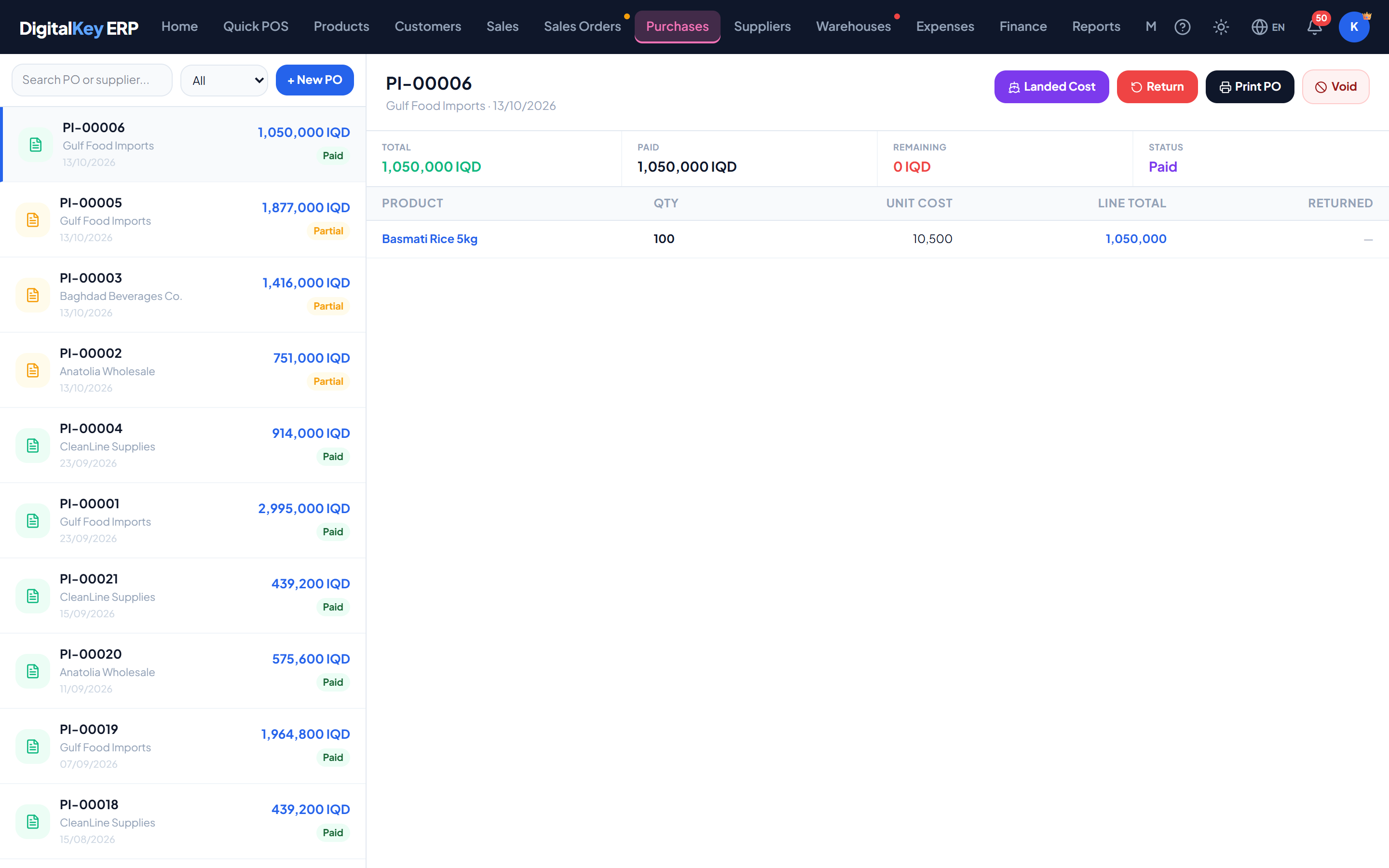
The purchasing features
| Parameter | Type | Required | Description |
|---|---|---|---|
purchase.manage | 5,000 IQD | Optional | Purchase invoices — the core of the module. |
purchase.suppliers | 2,000 IQD | Optional | Supplier records and their balances. |
purchase.orders | 3,000 IQD | Optional | Purchase orders raised before goods arrive. |
purchase.receive | 2,000 IQD | Optional | Receiving goods against an order. |
purchase.payments | 1,500 IQD | Optional | Recording payments to suppliers. |
Two ways to buy
You do not have to raise an order. Both routes are supported, and which you use depends on how far ahead you buy.
- Order first — raise a purchase order, send it to the supplier, then receive goods against it as they arrive. Best when there is a gap between ordering and delivery.
- Invoice directly — record a purchase invoice when the goods and the paperwork turn up together. Best for cash-and-carry buying.
Suppliers
A supplier record carries their details and a running balance of what you owe them. Buying on credit increases it; paying them reduces it. Suppliers have their own screen — see Suppliers.
purchase.suppliers2,000 IQD / monthWhat a purchase line can carry
- A new product — a product that does not exist yet can be created on the line, with its selling price, so it is sellable as soon as it arrives.
- Packing — the unit, Items per Unit, barcode, image and carton size, recorded on this purchase only; the product card is not changed.
- Freight by volume — a cost per CBM, which becomes a landed cost on the goods.
- Cost mode— whether the receipt blends into the product's average cost, uses a cost you type, or leaves the cost alone.
The last three are covered in Receiving Goods and Landed Costs & Cost Mode.
Owner permissions on purchases
| Parameter | Type | Required | Description |
|---|---|---|---|
Void a purchase | off by default | Optional | Cancel a purchase invoice, reversing its stock and the supplier balance. |
Purchase returns | on by default | Optional | Send goods back to the supplier. |
Set product cost by hand on a receipt | off by default | Optional | Use the “Enter the cost myself” and “Keep the current cost” modes. |
Purchase invoices
| Parameter | Type | Required | Description |
|---|---|---|---|
purchase_id | integer | Optional | Internal identifier. |
invoice_no | string | Optional | Invoice number. |
supplier_id | integer | Required | Who supplied the goods. |
po_id | integer | Optional | Linked purchase order, when the invoice came from one. |
purchase_date | timestamp | Optional | Date of the purchase. |
subtotal | decimal | Optional | Total of all lines before invoice discount. |
discount_amt | decimal | Optional | Invoice-level discount. |
total | decimal | Optional | Amount payable after discount. |
paid_amount | decimal | Optional | Amount already paid. |
remaining | decimal | Optional | Still owed on this invoice. |
payment_type | string= cash | Optional | Cash or credit. |
total_returned | decimal | Optional | Value returned to the supplier against this invoice. |
is_void | boolean | Optional | Whether the invoice has been voided. |
Returns to supplier
Faulty or surplus goods can be returned. The return reduces stock and reduces what you owe, and is recorded against the original purchase invoice. Each return can be printed.
Voiding a purchase
Voiding reverses the stock and the supplier balance. The stock is taken back out at what it actually cost — including any customs or transport it absorbed — so the product's average returns to where it was.
Money out for goods
In this section
- Suppliers — who you buy from, and what you owe them.
- Purchase Orders — raising and tracking an order.
- Receiving Goods — turning an order into stock.
- Landed Costs & Cost Mode — customs, transport and how a receipt moves the cost.